

How Businesses Are Being Targeted by Modern Cyber Fraud in 2026
- May 12, 2026
- Tarachand
- Technology Strategy, AI & Automation, Cybersecurity, Company News
- 5 Mins. Read
Cybersecurity Is No Longer Just an IT Problem
For many businesses, cybersecurity used to feel like something handled only by the IT department.
That’s no longer true.
Today, cyber fraud can affect almost anyone inside an organization — finance teams, HR departments, operations managers, customer support staff, business owners, and even employees handling routine communication.
What’s changed is the way these attacks happen.
Modern cybercriminals don’t always try to “hack” systems in the traditional sense anymore. Instead, many attacks now look surprisingly ordinary:
- a WhatsApp message,
- a payment request,
- a shared document,
- a fake invoice,
- or a call from someone pretending to be a senior executive.
And that’s exactly what makes them dangerous.
Recently, our own team encountered a fraud attempt that served as a powerful reminder of how important awareness, verification, and internal processes have become for every business.
A Real Incident Our Team Experienced
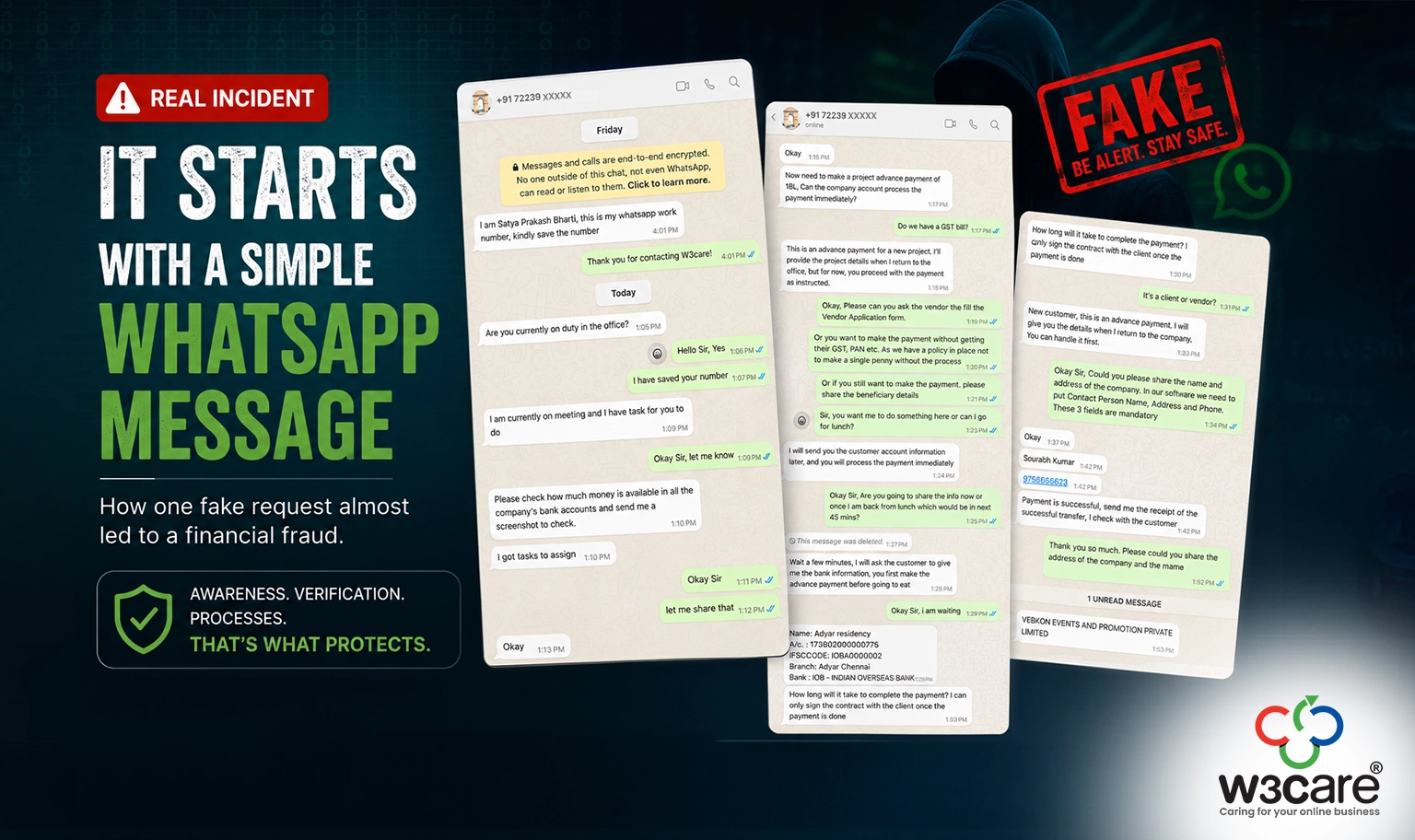
One afternoon, a member of our team received a WhatsApp message from an unknown number.
The sender introduced himself as a senior authority figure within the organization and asked the employee to save the number for future communication.
At first, nothing seemed suspicious.
The conversation started casually:
- asking whether the employee was in the office,
- mentioning ongoing meetings,
- and assigning a small task.
Slowly, the discussion shifted toward financial matters.
The sender asked the employee to:
- check company bank balances,
- prepare for an urgent payment,
- and arrange an advance transfer for a “new project.”
Throughout the conversation, the attacker repeatedly created pressure:
- “The client is waiting.”
- “The agreement needs to be finalized today.”
- “This payment must be processed urgently.”
At the same time, the person avoided direct verification by saying things like:
“I’m currently in a meeting.”
This is a very common social engineering tactic.
The goal is simple:
create urgency, avoid verification, and push someone into acting quickly.
Fortunately, our internal process required additional verification before any payment could move forward.
Instead of reacting emotionally to the urgency, the employee started asking for:
- GST details,
- vendor information,
- company address,
- onboarding documents,
- and beneficiary verification.
As more questions were raised, inconsistencies began to appear.
Some information was incomplete.
Certain responses became vague.
The urgency kept increasing, but the documentation never became clear.
That’s when it became obvious that the entire conversation was likely a fraud attempt.
Thankfully, because proper payment procedures were followed, no financial loss occurred.
Looking back, the incident reminded us of something important:
Modern cyber fraud doesn’t always attack systems first.
Sometimes, it attacks trust.
Why This Scam Felt So Real
What made this attempt particularly concerning was how normal it felt.
There were:
- no obvious spelling mistakes,
- no suspicious-looking links,
- no dramatic threats,
- and nothing that immediately felt “fake.”
Instead, the attacker relied on:
- authority,
- urgency,
- familiarity,
- pressure,
- and natural conversation.
And honestly, during a busy workday, many people could easily respond without noticing the warning signs immediately.
That’s how modern business fraud works.
Today’s attackers often study human behavior more carefully than technology itself.
Fake Payments & Invoice Frauds Are Increasing
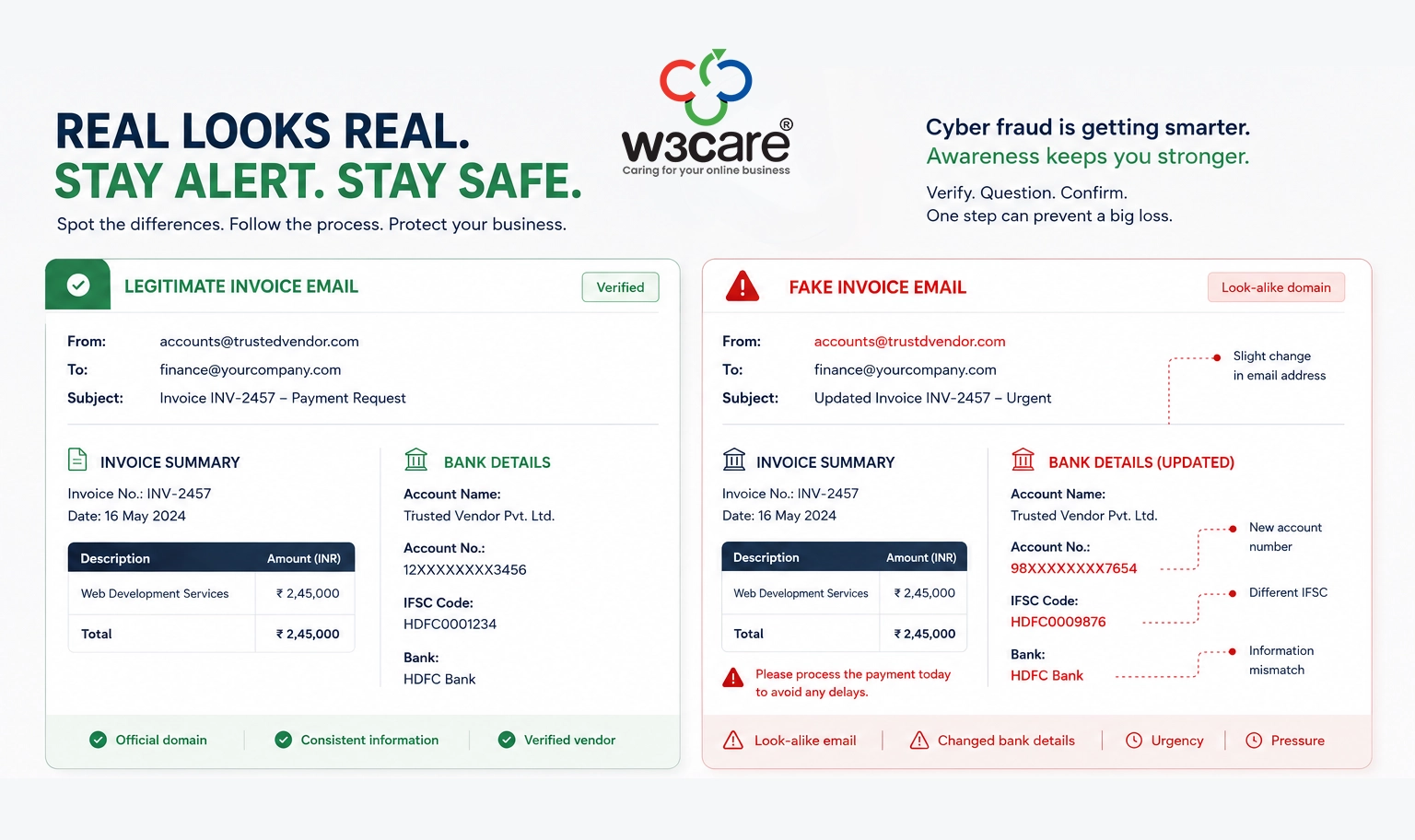
Businesses across industries are increasingly facing fraud attempts involving:
- fake vendor invoices,
- modified bank account details,
- advance payment requests,
- fake purchase orders,
- and impersonated suppliers.
Sometimes the attacker uses an email address that looks almost identical to a real vendor’s email.
Other times, they claim:
“Our bank account has recently changed.”
Or they create urgency with messages like:
“Please process this payment today to avoid delays.”
Unfortunately, many organizations only discover the fraud after the payment has already been completed.
Fake Login Pages & Access Requests
Another growing threat involves fake login portals and access requests.
Employees may receive:
- fake Google login requests,
- Microsoft 365 verification links,
- fake hosting support portals,
- “secure document access” invitations,
- or document-sharing links that appear legitimate.
These pages are often designed to look genuine.
The objective is usually to steal:
- passwords,
- email access,
- authentication sessions,
- or confidential business information.
Even experienced users can sometimes get confused — especially when working quickly or under pressure.
What Actually Protects Businesses
Many people assume cybersecurity is only about:
- firewalls,
- antivirus software,
- or expensive security tools.
Those things are important.
But in reality, some of the strongest protection comes from operational discipline and employee awareness.
In our case, the fraud attempt failed because the employee followed the process instead of reacting to urgency.
Simple verification steps made all the difference.
Businesses should strongly consider implementing:
- payment approval workflows,
- vendor verification procedures,
- mandatory documentation checks,
- multi-level approvals,
- employee awareness training,
- multi-factor authentication (MFA),
- and internal escalation policies.
Most importantly, employees should feel comfortable slowing down and verifying unusual requests — even if they appear to come from senior leadership.
Final Thoughts
Cyber fraud is evolving rapidly.
The most dangerous part is that modern scams often no longer look suspicious in the traditional sense.
They look professional.
They sound normal.
They feel urgent.
And sometimes, they appear completely legitimate.
That’s why awareness, communication, and strong internal processes are becoming just as important as technology itself.
Sometimes, preventing a major fraud comes down to:
- one careful question,
- one verification step,
- or one employee choosing to follow the process.
Businesses today need more than just technology.
They need awareness, secure systems, reliable processes, and proactive cybersecurity practices.
At W3care Technologies, we help businesses maintain secure and professionally managed digital infrastructure with proactive monitoring, operational best practices, and cybersecurity-focused support.
- Still Running PHP 7.4? Upgrade Before It Costs Your Business
- How Businesses Are Being Targeted by Modern Cyber Fraud in 2026
- W3care Featured in Evan Kirstel’s Trusted IT Providers — Clutch B2B Expert Picks
- Magento’s Roadmap to the Future: What Lies Beyond 2025?
- WhatsApp Business Platform Pricing Changes in 2025: What Businesses Should Know
- Which E-Commerce Platform is Right for You?
- Upgrade ExpressionEngine Website | Secure, Future-Proof and Optimize.
- W3care Technologies Celebrates 15 Years of Excellence.
- Choosing the Right Website in 2025: No-Code, Low-Code, or Full-Code?
- Fintech: The Indian Financial Sector Experience